Rebecca Boushier Paulson
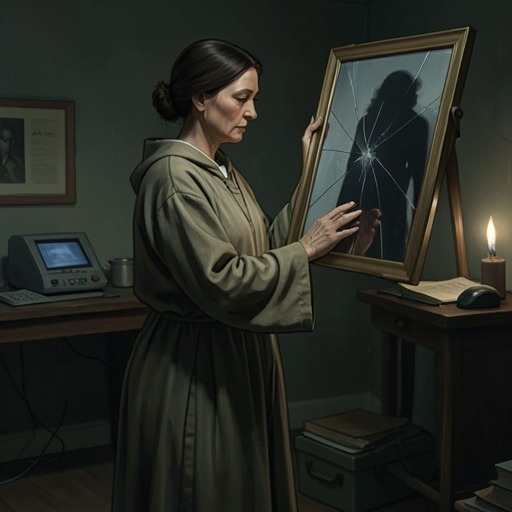
The TommyknockersRebecca Bouchard Paulson, usually called ’Becka, becomes a listener to the speaking image of Jesus on her television, which tells her that Joe Paulson is unfaithful and then discloses other concealed crimes. Its revelations unsettle her, but she cannot bring herself to stop listening; at the same time, it teaches her to construct an electrical device. When she wires the device into the television, Joe is fatally shocked, and the image of Jesus bursts apart. ’Becka’s brief passage from betrayed wife to maker of the device that kills her husband turns the domestic television into both a source of forbidden knowledge and the instrument of an irreversible consequence.
Identity and Household
’Becka is married to Joe Paulson, one of Haven’s two mail carriers and a third of its postal staff. The evidence presents her as a forty-five-year-old woman living in a household organized around ordinary routines: television, snacks, Joe’s work, and his interest in baseball. Their son Byron has left home. Against this familiar background, the television becomes the setting for disclosures that Joe does not notice and ’Becka cannot easily absorb.
The image of Jesus is a lifelike three-dimensional picture given to the couple as a wedding present by ’Becka’s older sister, Corinne, who lives in Portsmouth. It has occupied roughly the same place in the living room for about sixteen years, first atop two Zenith televisions and, for the preceding six years, atop their Sony. For ’Becka, the image represents something sacred and beautiful, not an object whose value can be measured by its price. Its familiar place in the home makes its sudden speech all the more disruptive.
Revelation and Compulsion
The image first speaks to ’Becka just after three in the afternoon on a Thursday, as she returns from the kitchen with a snack and prepares to watch General Hospital. She has not entirely given up hope that the characters Luke and Laura will return, though she no longer fully believes it. At this ordinary moment, Jesus tells her that Joe has been having an affair with Nancy Voss, a postal colleague, during lunch breaks and sometimes after work. The revelation gives ’Becka knowledge she had not possessed before; Bobbi Anderson already knew of the affair, but now Joe’s wife knows too.
In the days that follow, Jesus tells ’Becka other terrible things about Haven. The disclosures distress her, disturb her sleep, and make her afraid to go into the village in case her knowledge shows on her face. They also take away her appetite and lead her to bite her fingernails, a habit she has never had before. Joe notices the nail-biting but gives it little attention, absorbed instead in his work, baseball, and affair. The contrast is stark: what is transforming ’Becka’s inner life barely registers with the man closest to her.
Her response to Jesus is divided. The knowledge sickens and frightens her, yet she finds it compelling; she wonders whether the revelations are, in some unsettling way, also wonderful. She will not tell the image to stop or turn it face down. Her belief that Jesus is the Savior makes refusal especially difficult, while the compulsion to know keeps her listening even as the knowledge erodes her peace of mind. The supernatural disclosure does not simply inform her; it binds her attention to the source of what she learns.
Instructions and the Television Device
Jesus does more than reveal secrets. It tells ’Becka she can build a small device if she can follow a recipe, and she discovers that making it is easy and enjoyable. She works with a toaster, the motor from an old Hamilton Beach blender, and an electronics board taken from an old radio in the shed. Using Joe’s blowtorch and a kitchen match, she solders wires where Jesus directs. The work gives her a new practical task, but its apparent simplicity conceals the danger of what she is making.
Before Joe comes into the living room, ’Becka finishes wiring the device into the back of the Sony television. She follows Jesus’s instructions carefully; the image has warned her that the area behind a television holds enough electrical power to be dangerous, even when the set is turned off. Joe enters to find the television off and complains that she has not warmed it up for him. The domestic misunderstanding places the device within their familiar household routine, even as the hidden wiring has changed what the television can do.
Joe’s Death and the Destroyed Image
Joe is fatally shocked when the device operates: his clothes catch fire, and the living room fills with the smell of cooking beer. The three-dimensional image of Jesus jitters and then explodes. The source that had instructed ’Becka and supplied her with forbidden knowledge is destroyed at the same moment that the device she built takes effect.
’Becka understands that she has caused what is happening. She runs to Joe and takes hold of his convulsing hand, only to be struck by the current herself. Her immediate appeal for salvation does not change the outcome. In the final reversal, the father’s mocking voice rises in her mind, recalling his earlier lesson about lying and secrets. That voice frames the catastrophe through an old fear of being caught in a lie, while the scene itself makes the present responsibility unmistakable: ’Becka built and installed the device, and Joe dies as a result.
Narrative Significance
’Becka’s plot joins revelation to action. Jesus’s disclosures make her a reluctant repository of Haven’s hidden wrongdoing, while its practical instructions lead her to make the device that brings about Joe’s death. Her knowledge is therefore neither safely passive nor simply liberating: it unsettles her, changes her behavior, and culminates in an act whose fatal consequences she recognizes too late to prevent.
The television is the story’s central domestic object in her arc. For years it has supported an ordinary household image of Jesus; then the image speaks, walks within its picture, and guides ’Becka’s hands at the very set where Joe expects to watch baseball. Once the device is wired into the television, the familiar appliance becomes dangerous, and the image itself is destroyed. ’Becka’s ending compresses the arc into a grim sequence: she listens, she builds, Joe is killed, and the source that instructed her vanishes.